
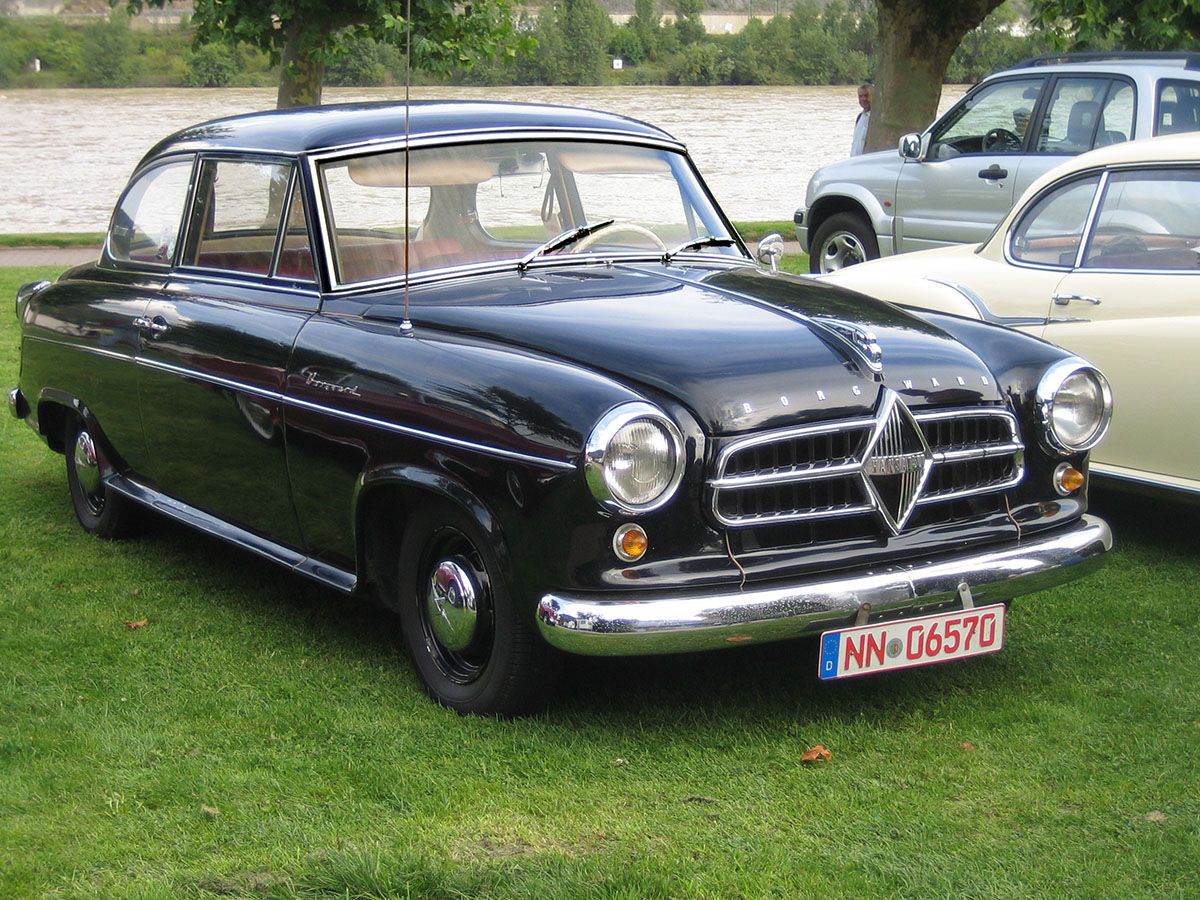
Big badge: Borgward Hansa Isabella saloon. © Lothar Spurzem, CC BY-SA 2.0 DE
You know what it’s like. You spot an interesting car in the distance and before you can get a good look at it, off it goes in the wrong direction. It can bother you all day.
I was walking back from the shops when just such a car appeared in a side road. The rounded shape and beige paintwork marked it out as something with a history to it. And it sported the biggest grille badge I’ve ever seen, but it was too far away to read the name.
Unfortunately, it turned away from me so I never got to identify it. But I did memorise the registration number and when I got home it didn’t take much of an internet search to find not just a similar one, but the very car I’d seen.
It was a Borgward Isabella. A what? Never heard of it. They are a pretty rare sight on UK roads, but back in the Fifties and Sixties they were one of Germany’s finest cars. More than 202,000 Isabellas came out of their Bremen factory.
My online search led me to the UK Borgward Drivers’ Club with more than 100 members who meet regularly at Brooklands. And there, in their gallery, was the beige beauty I’d spotted though, sadly, with few details.
Searching further I discovered the Isabella was launched in 1954, aimed at the better off middle class motorist – the BMW buyers of the day. It claimed a modern design, was innovative, roomy and lightweight. The 1,500cc push-rod engine performed well giving a top speed of 81mph and was capable of 38mpg – very respectable for the time. But it was plagued by unreliability and the high number of warranty claims would contribute to the company’s demise.
Carl Borgward, born in 1890, left school at 16 to be an apprentice locksmith but later gained a mechanical engineering degree and became a partner in an engineering firm. He dreamed of making a two-cylinder sports car, but lack of cash meant his first product was a 120cc, three-wheeled delivery van which found favour with small businesses and the German postal service, who ordered hundreds. But that was just the start.
In 1929 Carl took over Hansa-Lloyd, across the road, who had been making electric, then petrol, cars and trucks since 1905. By the Thirties he was selling cars, trucks and buses under the Hansa name and in 1939 the first Borgward badged cars hit the road.
The factory was switched to armament production in World War Two and was largely destroyed. Carl was back in 1948 and, to get around materials rationing, set up three companies - Goliath, Lloyd and Borgward Hansa - which meant he would get three steel allocations.
The Borgward Hansa 1500 was Germany’s first new post-war car, followed by an 1800 and then the more advanced Isabella – the first to be badged solely as a Borgward. It was a best seller.
Borgward developed more cars including the stylish 100mph P100 Big Six – the first German car with pneumatic suspension and a keen rival to Mercedes Benz.
Carl’s companies became a massive concern making trucks, vans, buses, military vehicles and tanks, fire engines, boats, electric vehicles and, surprisingly, a helicopter. A Lloyd engine was used as a prototype by Subaru.
But running multiple companies was inefficient and costly and Carl was controlling it virtually single handedly while acting as chief technician and designer. Suddenly, in 1961 the conglomeration faced financial disaster and Borgward resigned. Mystery surrounded the bankruptcy because it was reported the company had settled all its debts. When Carl died two years later it is said he was a broken man.
The P100 tooling was shipped to Mexico where production trickled on for a while and Isabellas were assembled in Argentina in the early Sixties. The Bremen factory was later taken over by Mercedes who still build some of their cars there.
But the Borgward story continues. A Chinese company bought the name and now Borgward cars are being built in China with involvement by Carl’s grandson Christian Borgward. They have a small range of modern SUVs already selling in China with a European launch planned and they have even produced an electric concept car.
Mystery solved? You never know what’s coming round the corner, do you?